- Published on
How Do You Get Contractors to Act Like Employees?
I get asked about this quite a bit. One of the things people have said to me, explicitly, over the years is that I'm not a typical consultant. What everybody keeps coming back to is that I act as if I were an employee. I embed myself into the team, I work with the team, and I work with whoever I need to in order to get things moving faster.
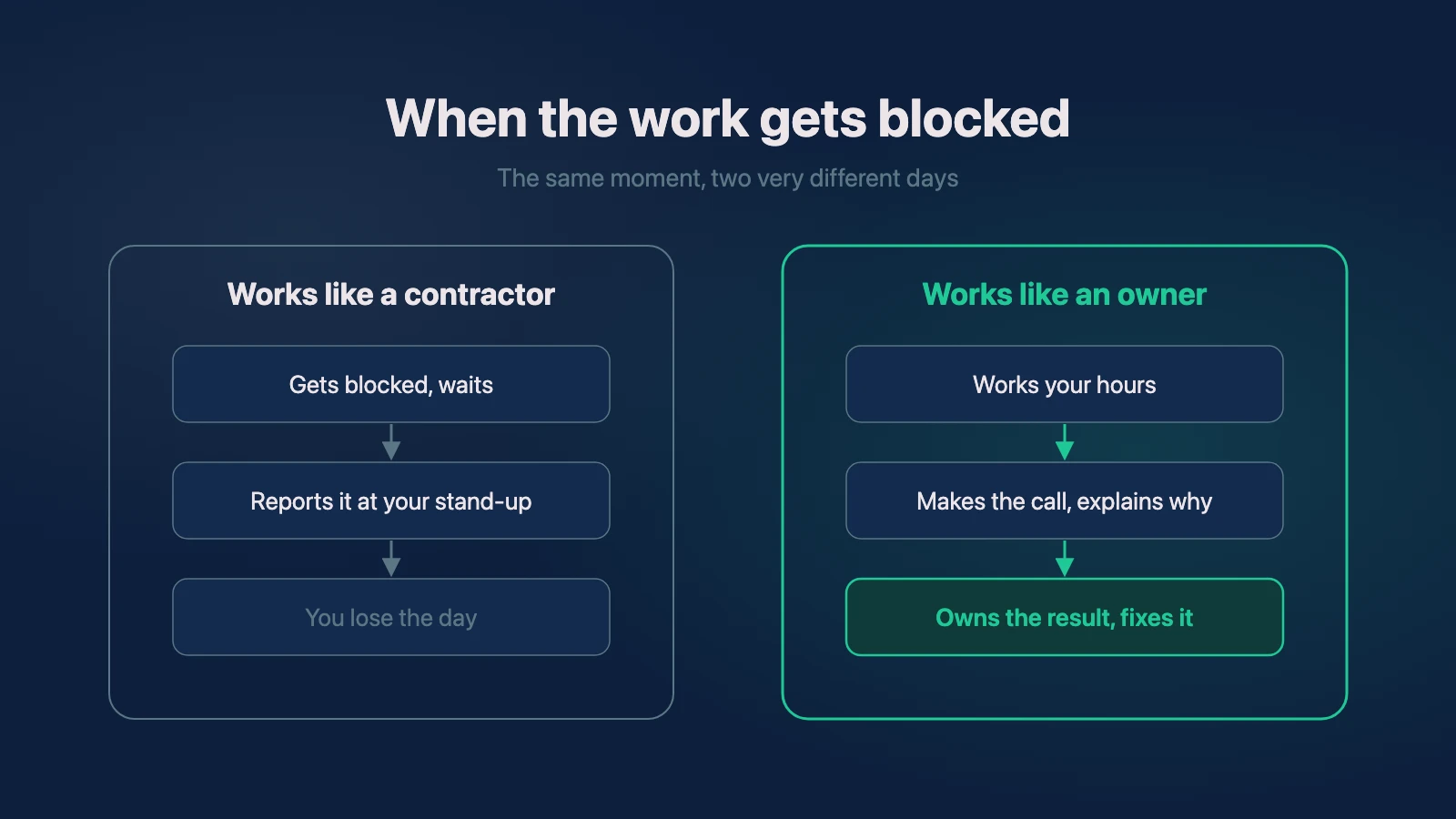
That came up again recently, and it got me thinking about the opposite. A lot of contractors, especially third-party teams that aren't based here in the U.S., have a mentality that once they're blocked, they're just blocked. They stand still. And plenty of contractors here in the States have the mentality that they can build for the hour, hope for the best, and never really have to worry about the consequences.
I think that's a terrible mentality, not only for the company, but even more so for the contractor. You're spending money on someone who isn't returning good dividends, and they're not growing, because they're not willing to take ownership.
So how do you get contractors to act more like employees? The short answer: hire people who work your hours and who have a record of owning their decisions, then be hands-on enough to find the one person on the team willing to lead, and give them room to do it. The rest of this post is the longer version.
Why does ownership matter so much?
Steve Jobs was pretty famous for not liking consultants. In a 1992 talk at MIT Sloan, he asked the room who had a background in consulting, and then explained his problem with it. Without owning something over an extended period of time, seeing your recommendations through and accumulating "some scar tissue for the mistakes," he said, "one learns a fraction of what one can."
I believe that to be 100% true. If you come in and you don't take ownership of your decisions, you don't live with the consequences. So you never really know whether you were right or wrong. You just take a leap and hope it pans out.
That's the first thing I think about whenever I get embedded into a team: how do I do this in a way that benefits the company even more than it benefits me? The last thing I want is to be in a situation where I just collect a paycheck. I don't care about that. I care about making a good product better, or a bad product great.
Should you hire a development team outside your time zone?
My hard line here: you should never be hiring or outsourcing your development work outside the four main U.S. time zones. If you can find a team that works Eastern, Central, Mountain or Pacific time, that's your best bet.
I can't tell you how many times I've run into companies that say they're having a lot of issues because their contracting team is based somewhere in East Asia. By the time the team is finishing its day, you're starting yours, and so much information gets lost. In some cases they get blocked very early in their day, sit there for eight hours, and then log on to your stand-up to tell you they were blocked and need you to unblock them. Now you spend the next eight hours unblocking them, and you've lost an entire day of work with that person. I don't know who would look at that and call it a good use of their money.
To be fair, I've noticed some teams, especially in Europe and Southeast Asia, changing so they overlap with U.S. companies for a few hours. If you start at 9 a.m. Central, they might work until noon or one o'clock your time. It's getting better. But even four hours of overlap is only decent. Things are going to pop up when they happen to you, and you want to be in control of that, or at least know how to delegate it in that moment. What you don't want is to see a ding at 2 a.m. that something's broken, and then not reach anyone until 9 a.m., when they're wrapping up their day. At that point you've paid them to do nothing.

A team that works your hours is there when the blocker shows up. The other two are not.
This isn't about the U.S. specifically. I write these for business owners here, but the same applies in Canada or Mexico. If you're in the U.S. and you hire a firm out of Canada, Mexico, or anywhere in Latin or South America, so long as they're in your time zone, I think that's perfectly reasonable. They're going to be there when you need them, and more than anything, you want them working your hours.
What about remote teams?
Remote work doesn't change this. If you're remote-first, or you let people work whenever so long as the work gets done, you still need time with everyone. If you follow Scrum, your stand-ups, refinements and sprint planning work fine wherever people are located, so long as they're working around the same time.
What you don't want is a meeting where everyone just had breakfast and dropped off their kids and is ready to start the day, and one person is ready to end theirs. That's a completely different mindset, and you want everybody on the same focus.
What should you look for when interviewing contractors?
Consultant interviews are usually one or two rounds. I've rarely seen more than two: typically a fit conversation with the manager and maybe a technical assessment. You can do whatever you want, I'm not going to stop you. But in those rounds, I'd check for three things.
First, can they articulate their process? When you ask a question, are they straightforward with you? Can they explain the good, the bad and the ugly? Nobody likes talking about the bad or the ugly, but when someone can walk you through the lessons they've learned, you know they're not just going to take a thought and run with it. They'll ask questions beyond what was asked of them.
There's a question I ask my AI agents all the time: are you 100% sure this is complete? Very often it comes back and says no, it's not actually certain, and then it works through all the things it missed. The same idea works in an interview. Tell me about a time you took ownership of something that went wrong, and what you learned. Tell me about a time things went right even though the odds were against you. Treat the interview like you're hiring a full-time employee. (I've written more about what I look for when hiring a developer, and most of it applies here too.)
Second, their technical aptitude. I don't agree with large technical assessments, but I do think you need to test for it in some way. And especially today, that includes how they use AI. Are they thinking critically about it? How do they know whether the AI is pushing up the right thing or the wrong thing? How do they know the code actually makes sense, and that they didn't accidentally break something along the way?
Third, and this is the big one: are they willing to take charge? Most consultants don't want to. They're in the game of getting the work done, collecting the paycheck and logging off. If that's what some people want, that's fine. But if you accept that in your culture, your app is not going to go very far.
When you hire people without that sense of urgency, you run into missed deadlines. You run into "we're limited on scope on this." You run into excuses. What you want is someone who will make a decision, own it when it doesn't work, and fix it. Or someone who takes a risk because they think it's better than what you originally had in mind, and you walk away with a much better decision than you'd have made alone. Find that person, and you'll get the return they deserve.
How do you get the team you already have to take ownership?
What if you already have a team? Maybe full-time hires, maybe a consulting firm you've already brought in. How do you get them there?
Be hands-on
You cannot be hands-off and hope for the best here. I can't tell you how many directors, vice presidents and managers have told me they wish their team would act more like this. The first question I ask is what they're doing to get the team there. Usually the answer is something like: I don't know, I let this other person handle it.
That's the first problem. If you're the person in charge of this team, or its point of contact, you need to be involved, even if it stretches you a little thin. You've been entrusted with this team. You're the one who gets the praise when it goes well, and you're the one who gets let go when it goes sideways. Where you land depends very much on how you treat them.
Find the one person willing to lead
Next, figure out who on that team is the stronger leader. There's a notion that most developers are introverts, and having seen some developers, I understand it. But there's typically one person who's willing to speak up a little more, to take charge, to say yes or no.
In fact, if you find someone who will say no, and can reason very clearly about why it's a hard no, that's probably the person you should be listening to. Someone who sets boundaries is going to be way more successful than someone who takes on every single request.
Give that person the opportunity to lead. Tell them what needs to get done and let them take charge. Say you want to start using AI and you don't know how: ask for their best ideas and let them run with it. If some of it stops returning real value, or others start complaining, then figure out how to limit it.
If you give one person the opportunity to grow, the rest will follow, because culture doesn't follow what you say. It follows what's being done. One person steps up, the next one says "hey, I could do that, let me help you out," and it grows from there.
I watched this happen with AI adoption. A while back I was watching a session at AWS re:Invent from a big airline's engineering team, if I'm remembering it right, about how they got hesitant developers to use AI. What they described was picking an "AI leader" on a team, putting them in charge of figuring out how to use it, and having them explain the benefits to everyone else. One person started using it, brought it to the next person, and it cascaded until the whole team was on board. Leadership works exactly the same way. (It's also how I'd roll out a new AI model to a team: start with one or two people, not everyone at once.)
Let them grow past their job description
Once you have people willing to do a little more, give them room to grow. Say someone was brought on only for the mobile app, but they're really interested in back-end work. If you have the opportunity, let them. They'll make mistakes, and that's what the rest of the back-end team is there for. They'll learn, they'll be grateful, and the new skill makes them better at mobile development too.
I'm seeing fewer companies hire for plain front-end work, web or mobile, and more hire for full-stack, because with AI people are expected to work across both. Whether that person stays or leaves, giving them room to learn makes it more likely they'll get two things done at once for you, instead of you waiting on two different teams.
Hire for people who can explain hard things
Finally, the high performers I've seen understand more than the ins and outs of software. I've been part of a lot of interviews, and the thing that always sticks out is whether the person can walk me through a difficult situation in terms someone non-technical would understand. If they can, and they're willing to voice an opinion even when they might be wrong, that's ownership.
You don't get those people just because they show up one day. You grow them. And if one does show up in one of your interviews, do everything you can to keep them happy from the day they arrive. I guarantee that person will grow into more than a general contractor.
Where does trust fit in?
You'll notice I've said the word ownership a lot. I think it gets missed. It's also exactly what I'm trying to bring when I come in to provide embedded product engineering leadership: I embed myself so I can take ownership of the outcome I was brought in for.
We do live in a world of competing priorities. As much as we'd like to believe everyone at your company has your business's best interest at heart, people have their own interests too: money, time, their careers. You can't say they shouldn't. But if you give people a way to bring what they want to do into your company, build them up and let them own it, you'll build a much stronger team than you would by only hiring people who are technically savvy.
I keep coming back to Simon Sinek's story about how the Navy SEALs pick their teams, which I've written about before. Performance is on one axis and trust is on the other. Everybody wants high performance and high trust, but those people are rare, and the SEALs would rather take someone of medium performance and high trust than a high performer they can't trust. I think the same is true of contractors. If you only hire for knowledge, you'll end up with a team that suffers, and burnout for the one person who knows everything. If you keep finding people with enough skill and a lot of trust, people tuned to ownership, you'll grow a team that really benefits you.
These are my general thoughts, and I'm sure there's more nuance depending on your team. But regardless of whether you're hiring full-time employees, consultants or contractors, I think this is more true than not: you should be hiring someone who's going to take ownership of your project.
Need help with your project?
Chris Martinez
Founder of CAM Software · Mobile engineer
Chris founded CAM Software in 2022. He leads embedded product engineering engagements for established companies with mobile-led products, inherited applications, and delivery challenges. His work spans product alignment, React Native and native mobile engineering, supporting web and backend systems, release reliability, and responsible AI delivery. He also operates software products owned and operated by CAM Software from Northwest Arkansas and works with teams nationwide.