- Published on
How Do You Make Your App Store Submissions Faster?
It's around this time of year that we tend to see a lot more submissions, and the App Store taking more time than normal. A lot of first-time developers and first-time companies trying to release an app, and even companies who already have apps out there but haven't launched a brand new one in a while, end up missing some things that are rather important.
So I want to hone in on what you should be thinking about, especially in quarter four, when it comes to getting an app through review.
The short version: the fastest way through App Store review is to give the reviewer less to check, give them everything they need to check it, and submit well before the holidays. A smaller first release reviews faster, every update after your first approval tends to go faster, and once November hits you're working with whoever is available to review your app.
Why does the first App Store review take so long?
Because they check everything. And when I say everything, I mean they literally go through every single option.
Apple's review isn't a secret process. The App Review Guidelines are public, and they're organized into five sections: safety, performance, business, design and legal. That's the giant checklist the review goes through. If you actually read it and double check your app against it, you have a much easier time.
They're not just checking your app, either. They're checking the user information you're collecting. Early in your App Store Connect setup you were asked what data you collect that can relate back to a user, and what permissions you're requesting. They check all of that against what the app actually does. They check your privacy policy. They check your terms of use or end user license agreement. If any of that isn't set up correctly, it's going to come up.
There's other stuff too, like your screenshots. Does your app actually make sense for what you're saying it does? In some cases an app gets rejected because it doesn't feel like it was made for general use. I've also seen apps rejected because the reviewer thought the app couldn't run, and when you dig into it you find out they weren't testing it the right way. Maybe that's just something you didn't explain well enough.
That's why they ask you for a login account. Apple's own guidelines say to include demo account info "and turn on your back-end service!" if your app has a login. The reviewer is walking through your entire workflow, especially anywhere you ask users for permission. And if you're doing something that should require permission and you're not asking for it, they're going to find that too. If you don't give them good testing steps and notes, you'll run into issues.
There are a lot of little things that get missed, especially the first time, or when it's been a long time since your last brand new app.
Does a smaller first release really get through faster?
In my experience, yes. Something I learned years ago, and that's been ingrained in the back of my mind ever since, is that you should launch a brand new app with the minimum viable product. The more you focus on what the real MVP is, the easier it is to get onto the App Store, and the easier it is to update it as needed.
I bring this up because a lot of organizations, especially the larger ones I've worked with, believe they need every main feature built and in the app before it goes to the store. And I completely understand that. I don't want to make it sound like a wrong decision, because I don't know every business's reasons. Some things really are required for a release to be useful, and that is more than acceptable. (I went through what an MVP needs to get right in 8 things first-time app creators need before launch.)
But here's the trade-off. The reviewer is going to test every single detail you give them. Fewer screens, fewer permissions and fewer workflows means less to test, and they can move through your app significantly faster. Sometimes that means moving a feature out. Sometimes it means recognizing a feature is necessary, but it can wait a few weeks or a few months.
The last thing you want is for your team to set a launch date, forget there has to be a review, and then deal with rejections from Apple, or from Google Play, that have to be fixed before anyone can download the app.
And here's a nice little tidbit. Every release after your first approval tends to go significantly faster. I've seen updates go through in as little as half an hour. I've also seen one take up to a week. But even then, it's usually faster than getting a brand new app approved. Apple says on its App Review page that it typically reviews at least half of submissions in under 24 hours and 90% in under 48 hours, and that incomplete submissions are what slow things down.
So if getting something smaller out the door means your first review goes smoothly, and every update after that goes through in hours, it might be worth it. I can't tell you the right answer for your product. But if you can get simple workflows and simple features out faster, that's usually your best bet.
When should you submit if you want to launch before the holidays?
In the US, Q4 has Veterans Day, Thanksgiving, Christmas and New Year, and I'm sure there are others I'm missing that people from different backgrounds observe. That means a lot of people take time off, and Apple and Google are companies that let their people do that. So you need to plan ahead.
Apple does tell developers about this. Years ago, App Store Connect shut down completely around Christmas and didn't accept submissions at all. Since 2021 it's stayed open, but Apple still warns that reviews can take longer. In 2024, Apple said reviews "may take longer to complete from December 20-26" and asked developers to "submit time-sensitive submissions early," as MacRumors reported at the time.
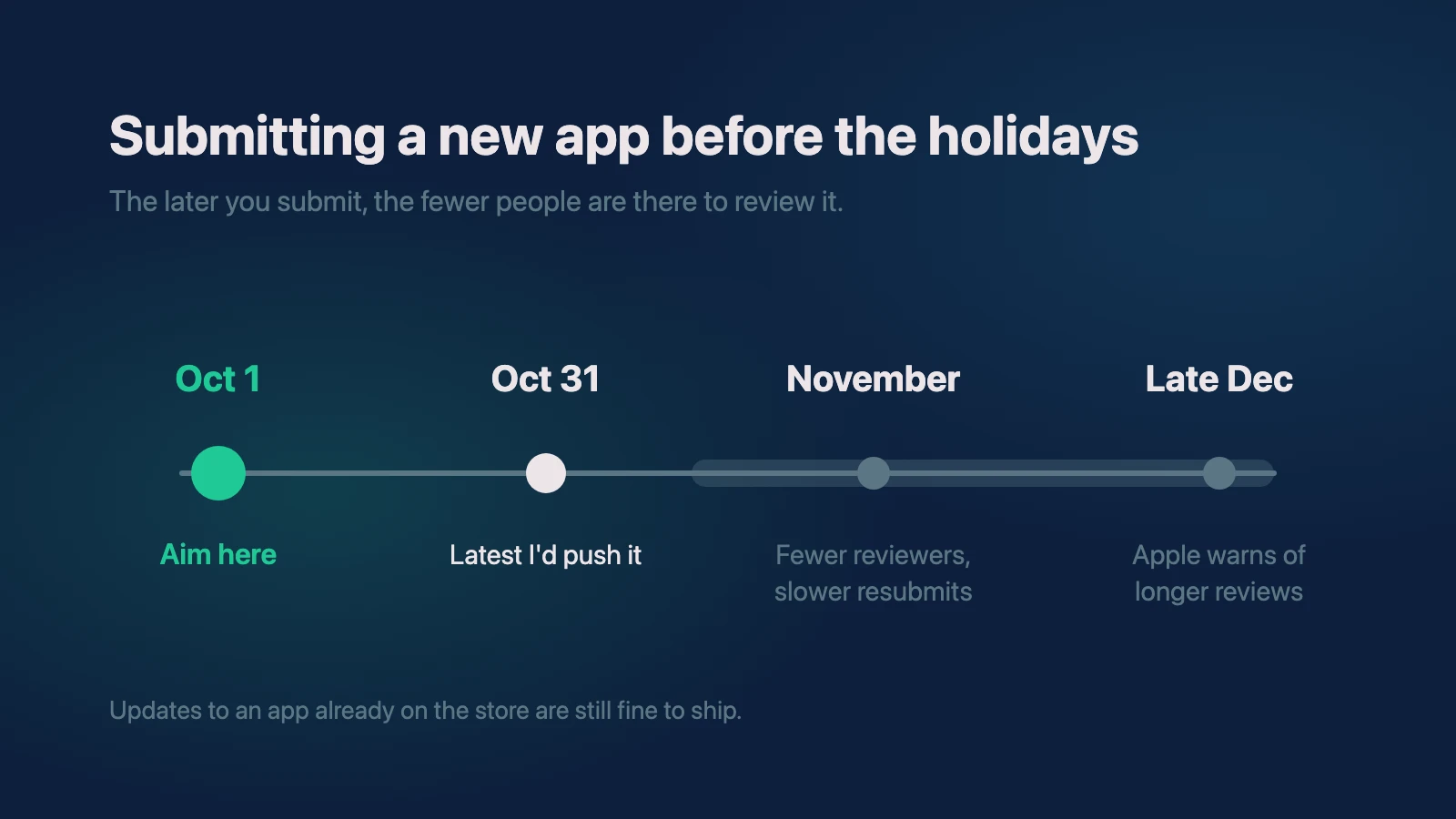
My own rule of thumb is more conservative than that. If you're launching a brand new app and you want it out before the holidays, aim to submit by October 1. If you absolutely have to push it, October 31 is probably the latest where you can still say you'll likely get in before the holidays. Once November hits, it gets harder. They're still just as meticulous, but there are fewer people available to review, and if you get a rejection, the resubmission is waiting on those same limited people.
In my experience, sometimes the same reviewer picks up your resubmission and sometimes it's someone new. You really don't know who you're going to get.
Google Play has its own version of this. Google's help page says a review can take "a few hours or up to seven days (or longer in exceptional cases)," suggests leaving at least a week before you go live, and notes that apps from new developer accounts can have longer reviews. So if this is your company's first Android app, give yourself more room, not less.
Does this mean you should never release around the holidays? Of course not. If you already have an app on the store and you have small changes or fixes, go ahead and ship the update. There's no issue with that. And if you have a brand new app ready, there's no reason to sit on it either.
Just don't expect special treatment. Apple does let you request an expedited review, but it's meant for things like a critical bug fix or an event you're directly tied to, not a launch date that slipped. At that time of year you're really at the mercy of whoever is there, and you need to be okay with that risk.
What if you keep getting rejected?
Then take a step back and check whether your app is actually set up correctly. Read the guideline they cited, and then check the rest of the list too, because one rejection reason often isn't the only one. I wrote more about that in the five categories Apple cares about.
Here's something I've found. Sometimes, if you go back, double check everything all over again, fix it, cancel the original submission and resubmit, it goes faster than staying in the original back and forth. But that only works if you have your ducks in a row for that second submission.
When is resubmitting better than replying? Honestly, it's very subjective. It depends on what they're asking you. If they want you to go back over the whole app, or everything you submitted for security or compliance, a fresh, fully checked submission can work really well. If they just have a few questions or concerns, it's usually worth answering them and waiting to hear back.
Typically when I've pulled a submission, I'm about three or four responses in with the reviewer. That's when I'll say, let's pull it, let's double check everything, and move forward. I find that's a lot faster. One caution on the Android side: Google says its review time is measured from the last change you submitted, so sending a new change while a review is in progress can put you back at the end of the line.
I'm honestly not sure how the review process works behind the scenes beyond what I've described. This is my experience, not Apple's documentation. If an update is already blocked and your customers are stuck on the old version, there's more on that situation on our App Store rejection page. When the same app keeps getting rejected, the cause is usually bigger than the last reply, and that's what a technical audit is for.
Why your last launch isn't a guarantee for this one
I personally have never had a submission drag on for days of back and forth. A day or two at most. But I've seen people go a week or two, because so many things were off that everything needed to be checked again.
Part of the reason is that the requirements keep moving. Apple's upcoming requirements page shows that since April 28, 2026, every upload has to be built with Xcode 26, and that developers had to answer new age rating questions by January 31, 2026. Google Play now requires new apps and updates to target Android 16 (API level 36), as of August 31, 2026. None of those existed a couple of years ago.
So you might be ready for a release, but if you're expecting it to go smoothly because of an app you shipped years ago, or even months ago, that might not be true anymore. Something might have changed.
Set yourself up for success. Make sure the people in charge of submitting know what they're getting into, read the current guidelines before you submit rather than after a rejection, and keep your first release as small as you can stand.
These are general thoughts from my own submissions. Your app and your reviewer may be different, but I think this is more true than not.
Need help with your project?
Chris Martinez
Founder of CAM Software · Mobile engineer
Chris founded CAM Software in 2022. He leads embedded product engineering engagements for established companies with mobile-led products, inherited applications, and delivery challenges. His work spans product alignment, React Native and native mobile engineering, supporting web and backend systems, release reliability, and responsible AI delivery. He also operates software products owned and operated by CAM Software from Northwest Arkansas and works with teams nationwide.