- Published on
Does AI-Generated Code Create Technical Debt?
The best analogy I have for what's happening in a lot of development teams right now: it's like handing a sixteen-year-old a Ferrari and saying, just go drive. You wouldn't expect that kid to drive safely, and it wouldn't really be the kid's fault. Nobody taught them the machine. They're going to want to go fast, because going fast is the whole point of the car.
That's roughly where we are with AI in software development. The tools are genuinely powerful, they're affordable, and they make developers faster at producing code. And to be clear about my own position: I love these tools and use them every day. But we're all still figuring out what they can and can't do, and how they fit each individual business, and while we figure that out, they're already at full speed in production codebases.
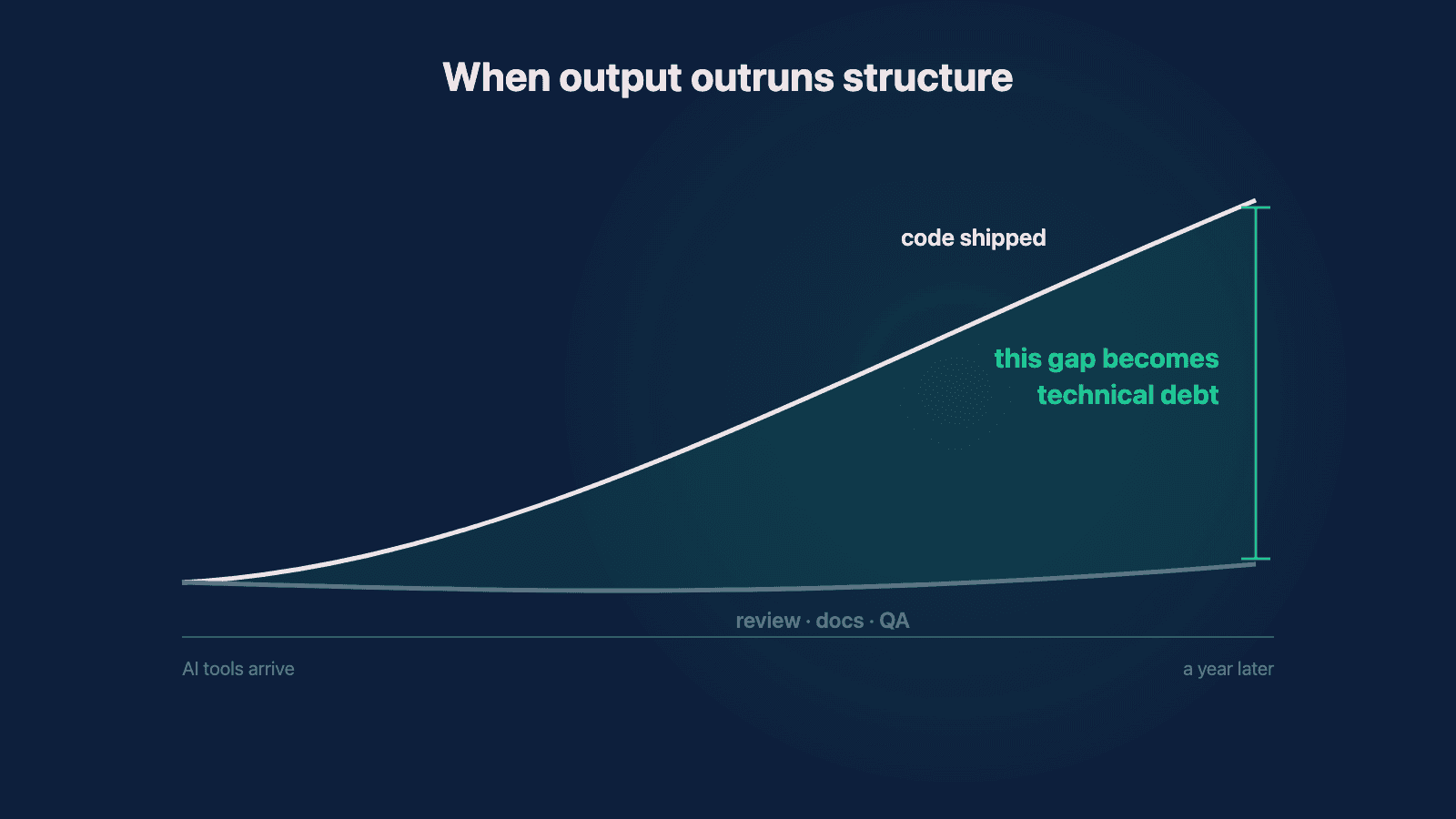
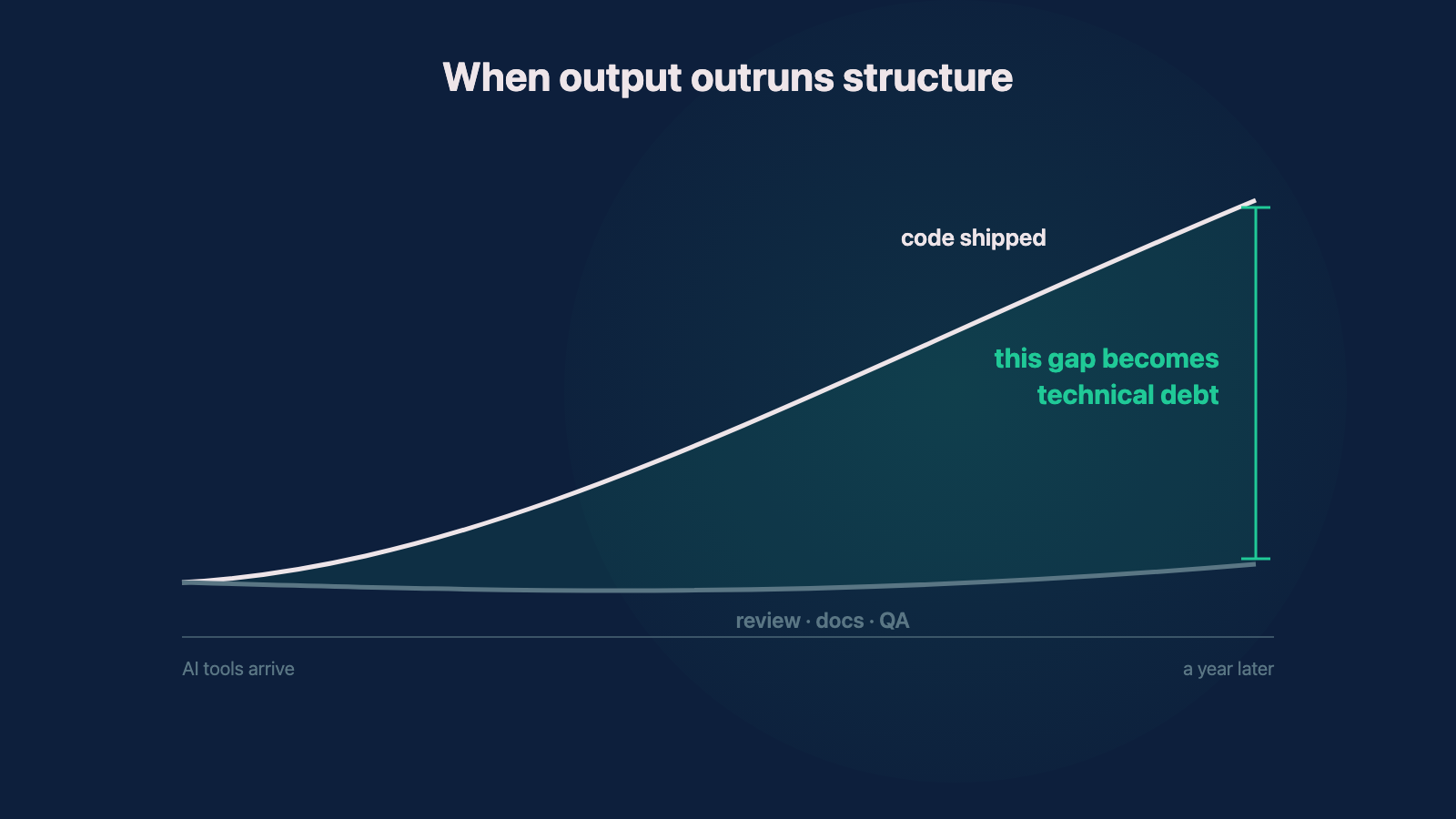
So, does AI-generated code create technical debt? Here's my honest answer: the code itself isn't the problem. The debt comes from the gap that opens up around it. AI made writing code faster, but it didn't automatically make code review faster, or documentation, or QA, or architecture decisions. When output speeds up and everything around it doesn't, the gap between them is where technical debt accumulates. Teams that manage the gap get the speed safely. Teams that don't are borrowing against their own future, without an interest rate anyone agreed to.
Where does the debt actually come from?
Watch what happens on a team that adopts AI for coding without changing anything else. Developers produce noticeably more code. But they're not taking proportionally more time to review that code, document their processes, understand their QA, or revisit the system design underneath it all. Every one of those activities was sized for the old rate of production.
Each individual shortcut feels small. One merged change that nobody fully read. One feature that exists only in the code, with no record of why it works the way it does. But these compound, because the next developer builds on top of the undocumented thing, and the next AI session gets prompted with the unreviewed thing as its example of how this codebase works. That's how you get what people have started calling AI slop: not one bad file, but layers of unexamined decisions stacked on each other.
I've written before about what AI actually does to a team's speed, and the honest version is that the teams getting the most out of it aren't the ones producing the most code. They're the ones who kept judgment in the loop.
When should a developer think, and when should they prompt?
One of the questions I find myself asking teams more and more: when should someone use their brain and Stack Overflow, and when should they hand the whole thing to AI? There's a real answer for every team, but the important part is that somebody asks the question at all. Deliberate usage is the difference between a tool and a habit (I've gone deeper on good and bad AI practices in a business).
Don't get me wrong: most developers are more responsible with this than the Ferrari analogy suggests, and I don't want to inflate the problem beyond what it is. The failure I see isn't reckless people. It's reasonable people inside a process that was never resized for the new speed, in companies where nobody was given the job of resizing it.
What does the fix look like?
The fix is structure catching up to speed, and in my experience it's less painful than teams expect.
Review has to scale with output. If AI doubles the code, human review can't stay a rubber stamp; this is exactly where a second set of eyes on the plan itself and automated review before merge earn their keep, with people still making the meaningful calls.
Documentation has to become part of the workflow instead of an afterthought. The teams doing this well treat updating the docs as part of finishing the work, and interestingly, AI itself is good at helping with exactly this part. The tool that created the speed problem is happy to help pay for it.
And someone has to own the whole picture: what gets used where, what the review gates are, what done means. On a team where no process or documentation exists, AI doesn't create the debt problem, it accelerates the one that was already there. If the codebase has already accumulated more of this than the team can dig out of, that's the point where a structured rescue makes sense, and if you're not sure how deep it goes, a bounded technical audit answers exactly that question.
These are working thoughts, and the tools are changing fast enough that some of this may read differently in a year. But the pattern underneath feels durable to me: speed that outruns structure becomes debt, whoever wrote the code. AI just made the outrunning easier.
Need help with your project?
Chris Martinez
Founder of CAM Software · Mobile engineer
Chris founded CAM Software in 2022. He leads embedded product engineering engagements for established companies with mobile-led products, inherited applications, and delivery challenges. His work spans product alignment, React Native and native mobile engineering, supporting web and backend systems, release reliability, and responsible AI delivery. He also operates software products owned and operated by CAM Software from Northwest Arkansas and works with teams nationwide.