- Published on
When Should Your Team Upgrade to a New AI Model?
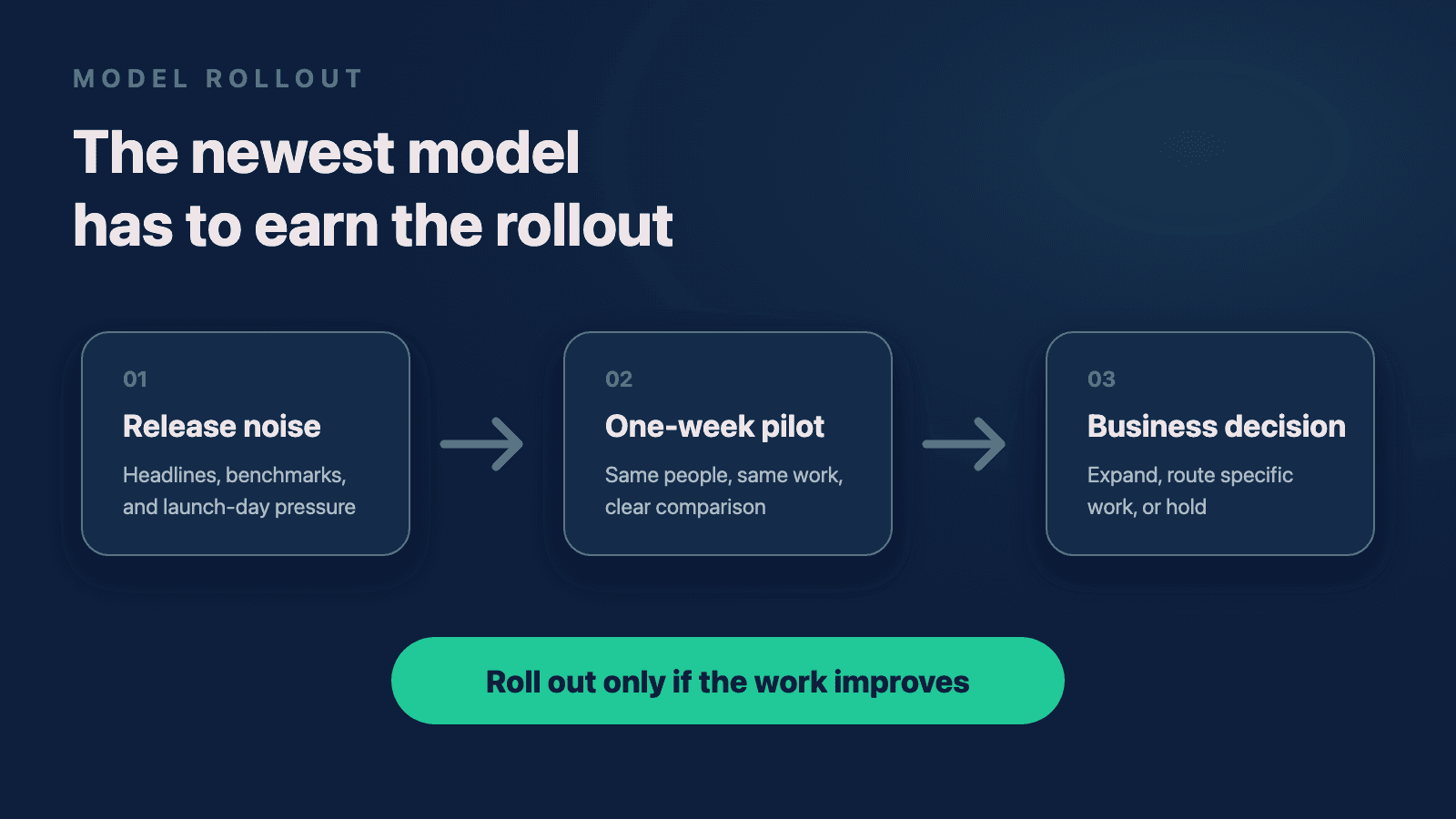
Over the last week, OpenAI introduced GPT-6 Astra and Anthropic introduced Claude Fable 5.1. Releases like these are exciting, but they also create a strange pressure. A new model arrives, everyone starts talking about what it can do, and suddenly the model your team used yesterday feels old.
That is not a good enough reason to change how your whole company works.
Here is my short answer: give a new model to one or two trusted, AI-fluent people for a week. Let them use it on the same work they were already doing. Then compare output quality, correction time, speed, and total usage. If the new model materially improves the outcome, expand access. If it does not, keep the model you already trust or reserve the new one for the few tasks where it earns its cost.
Should every developer get the new model immediately?
I would not recommend it.
I have worked with teams where some people use AI every day and understand how quickly usage can add up. Other people have access but have not developed the habits to get much value from it yet. Giving both groups a more expensive model at the same time makes it hard to learn anything. You see the bill change, but you cannot tell whether the work changed with it.
Start with one or two people per team who already know how to use these tools. I would usually choose a senior developer or the person already acting as the team's AI champion. The title matters less than the behavior. You want somebody who can compare the new model against last week's work, notice where it is better, and admit where it is not.
For a large organization, the pilot group can be bigger, but I still would not turn the first week into a company-wide rollout. The point of the pilot is to produce a useful signal before enthusiasm and cost spread everywhere.
What should happen during the first week?
Do not invent a special demo for the new model. Give it representative work.
If your team normally uses AI for planning, debugging, pull request reviews, research, documentation, or test generation, keep doing those things. Use a recent task completed with the old model as a baseline when you can. That comparison will tell you more than a public benchmark because it includes your codebase, your prompts, your skills, your review process, and your team's judgment.
I would run the week like this:
- Pick a few normal tasks that represent how the team actually works.
- Record how the current model performs before changing anything.
- Let the pilot group use the new model without rewriting the entire process around it.
- Capture where it saved work, where it created rework, and where people had to intervene.
- Compare the completed outcomes at the end of the week.
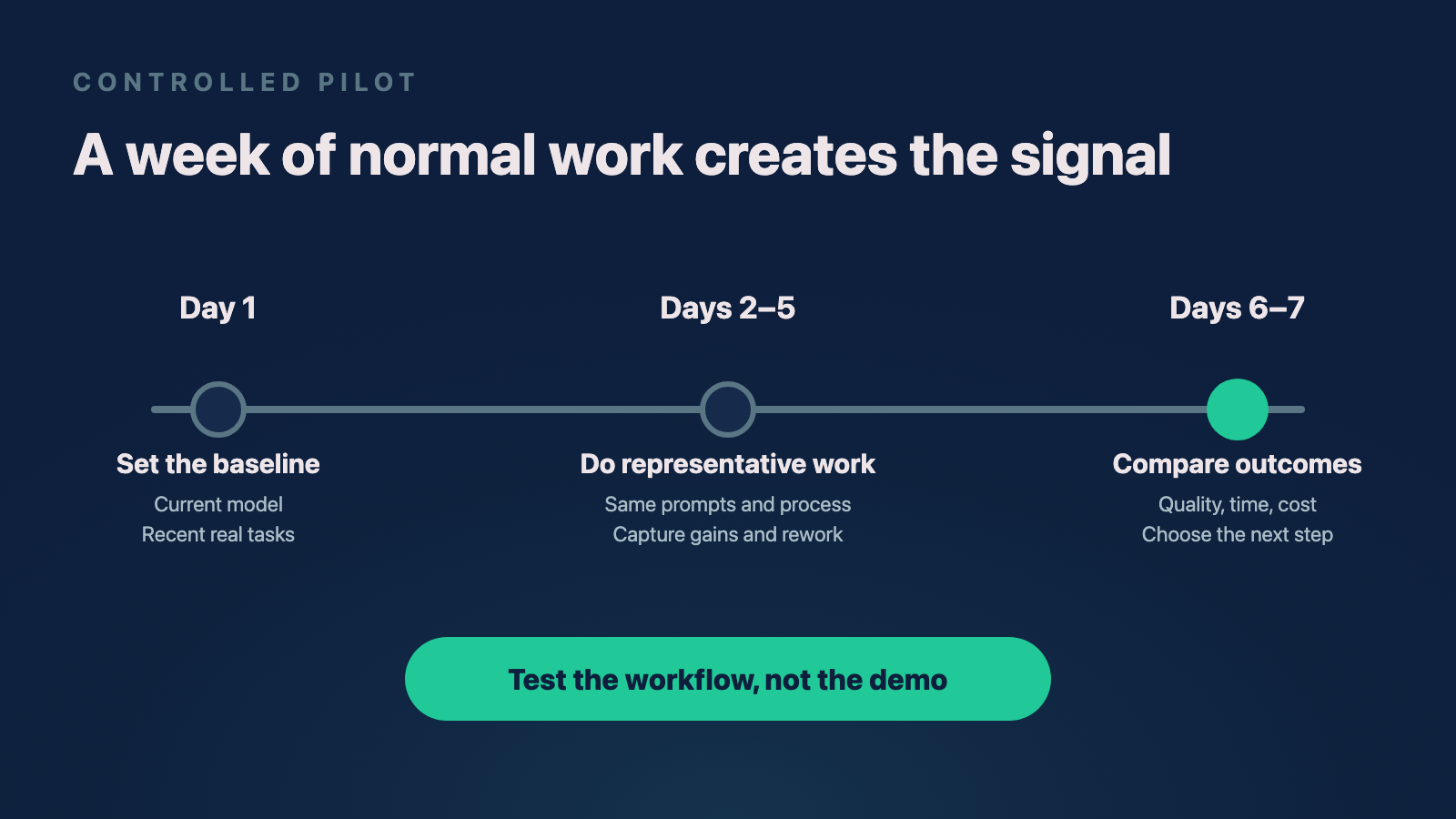 Keep the work normal enough that the result answers a real operating question.
A week is not a magic number. It is simply long enough to get past the first impressive answer and short enough to keep the test controlled. If the model affects a sensitive production workflow, you may need a longer evaluation and more formal safeguards. If it is only helping one developer summarize documentation, the decision can be lighter.
What should your team measure?
The wrong measurement is how many tokens or credits people used. Usage tells you what you spent. It does not tell you whether the company benefited.
This is the same distinction I made when writing about good and bad ways to use AI in a business: token consumption is a cost line, not a performance metric.
For a model upgrade, I would ask five questions:
- Did the output need less correction before somebody trusted it?
- Did the model complete difficult tasks the previous model could not handle?
- Did it reduce the total time from a real task starting to an approved result?
- Did the cost or usage per completed task change enough to matter?
- Did the model create new failures, review work, or security concerns?
Those questions can be answered with numbers, written observations, or both. You do not need a massive evaluation system to make a better decision. You need a consistent comparison and somebody willing to document what actually happened.
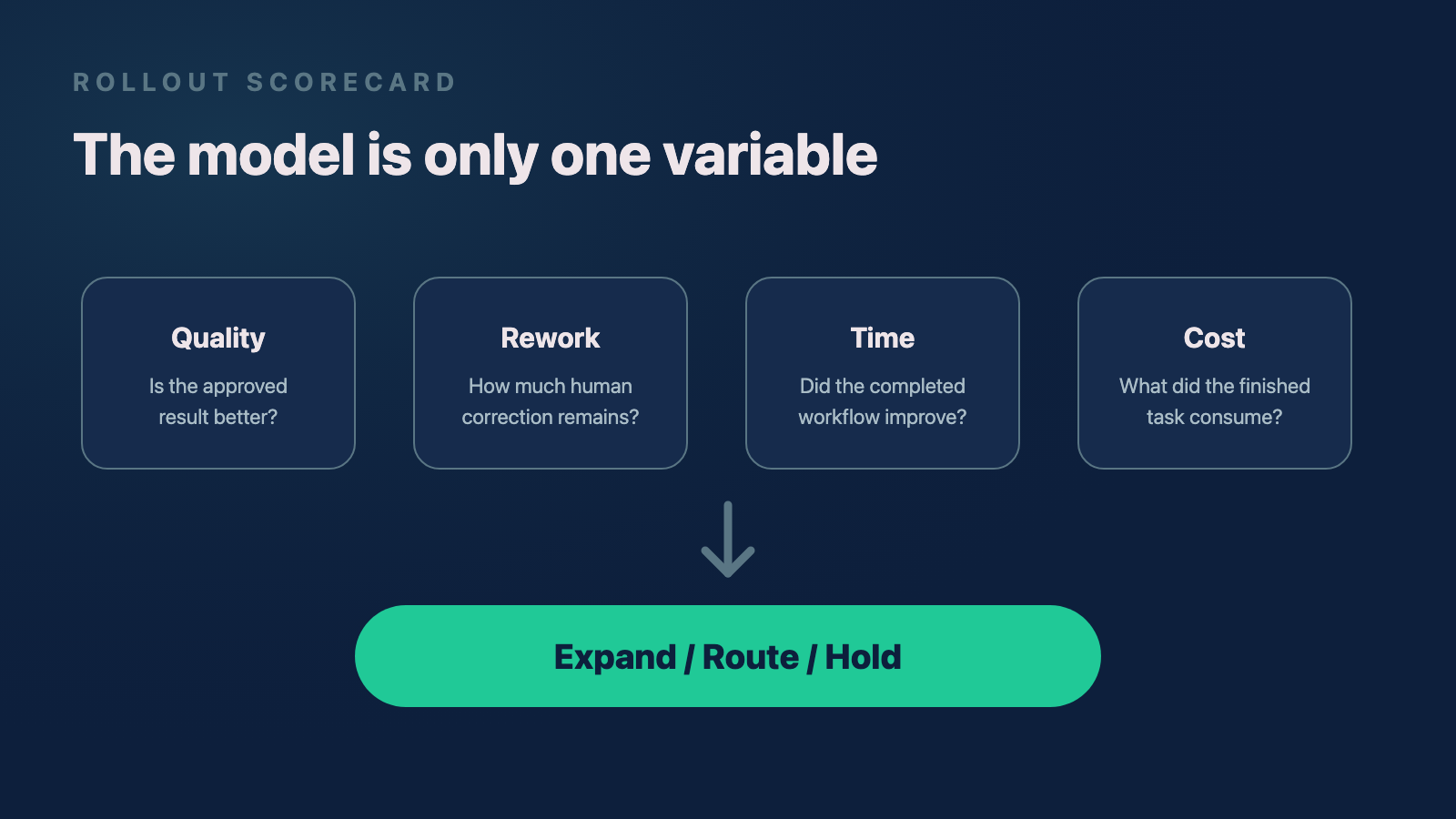 The decision is based on the completed outcome, not the model name.
When is a more expensive model worth it?
A higher-usage model can still be the less expensive choice if it solves a difficult problem with less rework. A cheaper model can be the better choice if the task is routine and the result is already good enough.
That is why I do not think one model has to win every category.
I have been testing Fable 5.1 and Astra against models I already use, including Opus 5 and GPT-5.6 Sol. The newer models can be impressive, but on some of my work they also use my allowance much faster. That does not make them bad models. It means I need to be more intentional about where their additional capability is worth the additional usage.
Sometimes I move back to an older model because it lets me finish more work across the week. Other times the harder model is exactly what I need for a deep research task or a complicated codebase. The right choice depends on the task, not on which release is getting the most attention.
Your team may end up with a similar split:
- A fast, efficient model for routine drafting, small fixes, and repetitive work.
- A stronger reasoning model for difficult debugging, architecture, or research.
- A fallback model your team already understands when a new release behaves unexpectedly.
Model selection is not loyalty. It is routing work to the tool that produces the best total outcome.
Does a better model automatically make the team faster?
Not necessarily.
I have already written about what AI actually changed on a development team. The largest gain was not a dramatically shorter calendar. It was better context, more issues found, and a stronger final product. A model upgrade can follow the same pattern.
A new model may identify more edge cases during a pull request review. That can initially look slower because the developer has more findings to examine. If those findings prevent a production issue, the extra review was valuable. If they are mostly noise, the model created work instead of removing it.
This is why the pilot has to include the human review step. The raw answer is not the finished product. The finished product is the answer after a qualified person checks it, corrects it, and decides whether it is safe to use.
Who should make the final rollout decision?
The people doing the work should produce the evidence. The business owner, CTO, or responsible leader should make the investment decision.
Your developers will often see the technical opportunity first. They know when a model understands the codebase better, reasons through a bug more clearly, or makes a frustrating workflow easier. You should listen to that. But the person responsible for the budget still has to ask whether the improvement is large enough to justify the spend and the change management around it.
That conversation works only when both sides are honest. The pilot group has to be willing to say the new model is not meaningfully better. Leadership has to be willing to hear that a higher cost is justified when the evidence is real.
If nobody owns that final call, every release becomes an informal upgrade and the company never learns what it is paying for.
What if the current model still works?
Then keep using it.
There are very few situations where every person on a team absolutely needs the latest frontier model on the day it launches. If an older model produces reliable work, fits the team's process, and leaves enough budget for the rest of the week, staying with it is a valid business decision.
You can test again later. Prices change. Allowances change. Models improve. Your own prompts and processes improve too. A model that does not earn a broad rollout today may become the obvious choice in a month, while a model that looked amazing on launch day may settle into a narrower role.
I am still strongly in favor of development teams using AI. I think tools like agentic pull request review can help people find issues earlier and understand a codebase faster. But supporting AI adoption does not mean approving every upgrade.
The model should earn the rollout. Give it real work, compare it against the process you already have, and let the completed outcomes make the decision. Your developers may still want the newest thing, and sometimes they will be right. The goal is to know why before the whole company starts paying for it.
Need help with your project?
Chris Martinez
Founder of CAM Software · Mobile engineer
Chris founded CAM Software in 2022. He leads embedded product engineering engagements for established companies with mobile-led products, inherited applications, and delivery challenges. His work spans product alignment, React Native and native mobile engineering, supporting web and backend systems, release reliability, and responsible AI delivery. He also operates software products owned and operated by CAM Software from Northwest Arkansas and works with teams nationwide.