- Published on
Should You Change Tech Stacks on a Live App?
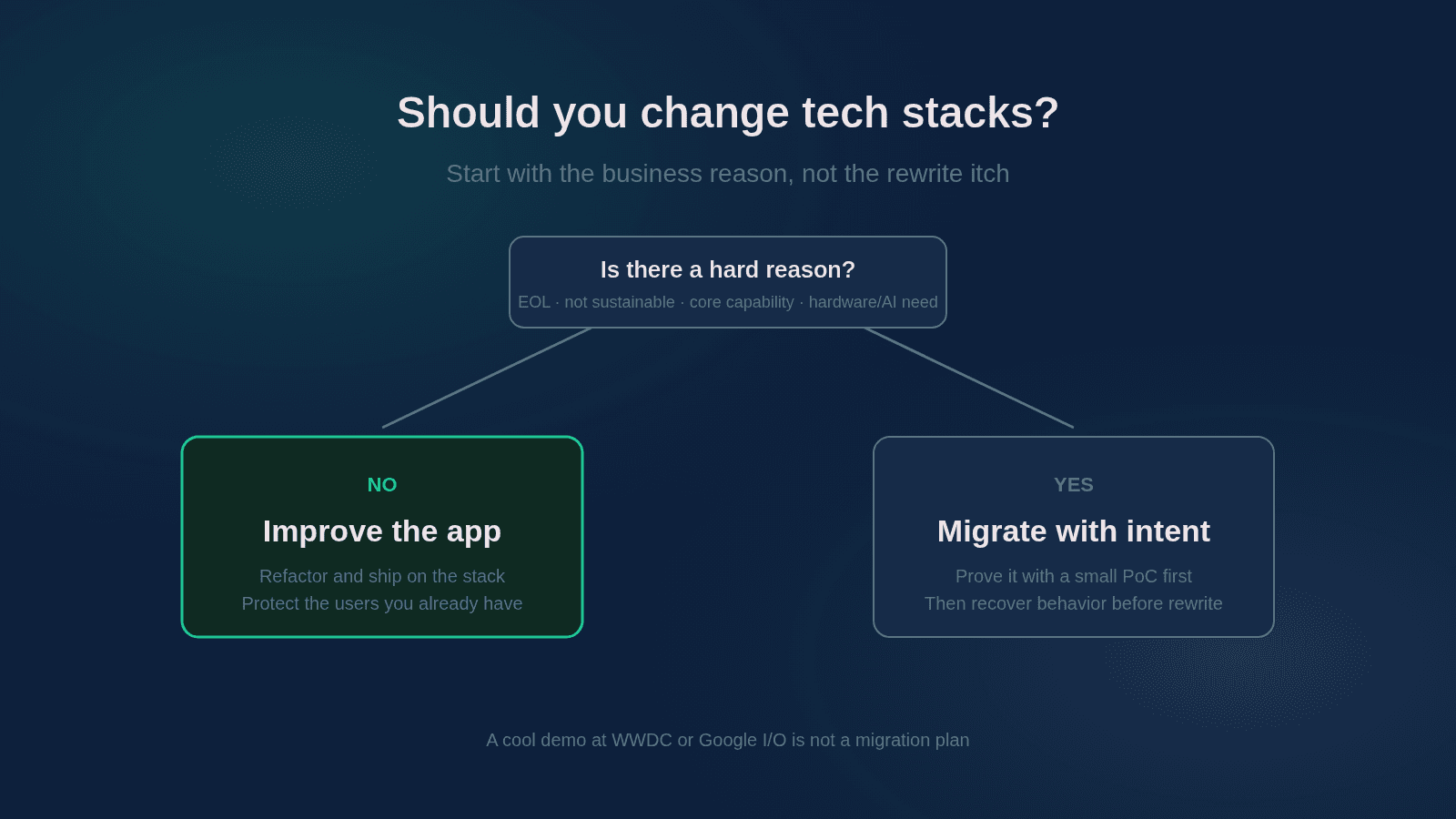
Yesterday I was scrolling Reddit and landed on a post in r/androiddev. From what I remember, the title was basically: boss wants to switch our 100,000-user native apps to Flutter for 3x faster delivery — should we buy this, or is it a bad call?
A lot of the comments boiled down to "this is a bad idea." I do not have the permalink verified, but the best reply I remember seeing said something close to: I haven't seen a successful full rewrite, especially to a completely new tech stack. It's always better to refactor the existing app.
I could not overstate how true that is. I've been in mobile since 2018. I've lived App Store and Play Store quirks, React Native tradeoffs, and enough rewrite meetings to know the pattern. I want to separate what is usually true from what sounds good in a planning deck.
Does changing tech stacks make the app easier?
Not by itself.
When you have a large live app, every decision to leave the current stack has to be intentional. Moving platforms does not magically simplify the product. It often creates problems you did not see coming, because the old app was carrying years of unspoken product rules inside it.
What a justified rewrite actually feels like
Years ago I helped a team move an app from Xamarin to React Native. That case was different. Xamarin was heading toward the end of support for them, and they had already decided they needed a path forward. When the current stack is no longer a viable long-term bet, migration can be the responsible move — the kind of exit path we outline on the Xamarin to React Native migration page.
Even then, it was hectic. We did not know how a lot of the product really worked. We had to reverse-engineer business logic, figure out what APIs returned, and reconstruct which parameters those APIs needed. There was a lot of guessing. One navigation screen never quite matched the old behavior because of time and tradeoffs. Users notice that kind of thing, even when the rest of the app improved.
And some things did improve. I remember product owners and executives saying the React Native version felt smoother and faster than the Xamarin app. So justified migrations can win. They just are not free.
Refactoring almost always wins when you do not have to leave
If you are thinking about migrating a 100,000-user app and you do not have to, pause. I have written about that tension before in Rearchitecture vs. Refactor, and the short version still holds: rebuilding is not the default fix.
Refactoring wins most of the time because you already understand the stack you are in. You can iterate. You can fix. Starting over is what is complicated. When the work is about shipping the next release with the stack you already have, that is Build work, not a rewrite theater.
Software culture loves the scrap-and-rewrite fantasy. Developers like building from scratch. A lot of us think we are better than whoever wrote the last version. I have sat in meetings where someone said the code was garbage, rewrote it, and months later someone else said the same thing about the new code. Sometimes the person complaining was looking at their own rewrite.
That feeling is not a business case.
Ask about the users before you ask about Flutter
If a rewrite would touch 100,000 users, start here: how many of those users are already satisfied?
If satisfaction is high and the product is making money with solid uptime, a stack change needs a much stronger reason than "delivery will be 3x faster." If a large share of users are unhappy, dig into whether the stack is actually the cause. Product problems, process problems, and workload problems love to disguise themselves as framework problems.
AI does not make a dual-native rewrite cheap
I have had the same conversation more than once lately: a team on React Native wants to move to SwiftUI and Kotlin / Jetpack Compose because native will be "easier" and AI will help them rewrite fast.
Even with strong AI tools, you still have to make the product right. Those tools are not 100% correct. And if you move to two native targets, you now have two platform implementations to maintain and review. Token burn and review cost show up on both sides. For an app that mostly calls APIs and renders screens, with no Bluetooth, no special hardware path, and no neural-engine constraint, that is often just a headache you bought early.
When a stack change is actually on the table
In my experience, changing tech stacks usually needs one of these:
- The current stack is losing support or is otherwise no longer viable.
- The current situation is truly not sustainable, and a different stack is the structural fix.
- The new stack unlocks a capability that matters to the business, not just to the engineering blog.
- There is a hardware or on-device AI constraint that the current stack cannot meet well enough.
If it is not one of those, you should probably stop talking about moving stacks.
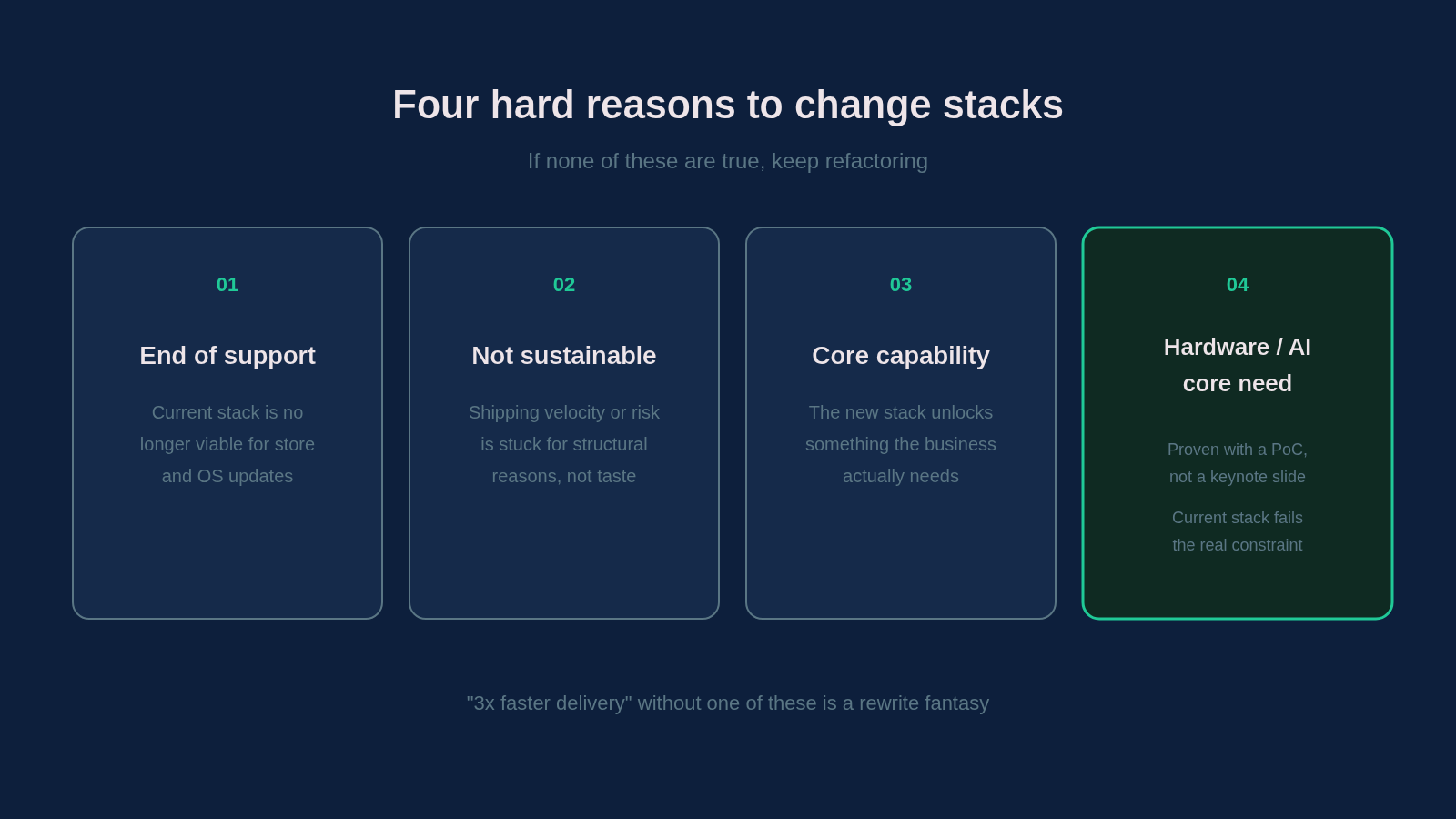
Four hard reasons. If none apply, keep refactoring.
Hardware is not an automatic ticket to native
I have worked with BLE / IoT apps that stayed on React Native and worked fine. There was a little lag in places, but it was not detrimental, and the community packages were good enough for the product.
Wanting "direct access to the hardware" is not enough. Ask what is actually broken today.
There are real exceptions. I saw a weightlifting app that used the selfie camera and on-device feedback for form. The team wanted one React Native codebase. Within weeks they learned the neural-engine path needed native work. Lag made the feedback too late to be useful. Moving that product toward Swift is what made the idea work. That is a constraint, not a vibe.
Spend a little on a proof of concept before you spend a lot on a rewrite
If you are unsure, do the due diligence. Research what your current stack can do. Build a small proof of concept on the alternative if you have the time and money. That is research and development, not waste.
I use the same logic on software subscriptions. If a tool is $20 a month or $100 a year, I will often pay monthly first. Paying for the year is cheaper only if I keep it. If I bounce after a week, the "deal" was the expensive choice.
Stack migrations work the same way. A small PoC that teaches you the truth is usually cheaper than a full rewrite that teaches you the truth too late.
I have yet to find a company that actually ran that experiment and came back wishing they had skipped it. The ones who put in the work usually say the clarity was worth more than rushing the migration.
Business owners have to pump the brakes
Your developers can be brilliant engineers and still be weak business owners. That is okay. It means you have to be willing to say no when the rewrite itch shows up without ROI attached.
If the app has solid uptime, the features users need, money coming in, and happy users, there is no purpose in rewriting for fashion. Stick with the current stack. If things get worse and there is a real major need, then go for it.
A Resume App example from my own roadmap
On The Resume App, we spent months looking at Apple's on-device neural engine for resume work. Resumes are small files. A proof of concept showed it was possible. Then we tried bridging from React Native into that native path and found the hard parts: battery concerns on some devices, and Android behaving nothing like iOS for the same idea.
We did not abandon the idea forever. It is still on the roadmap. But we did not rewrite the whole app to chase it. We kept shipping the approach that already worked: API calls across AI providers, pick the best result, keep moving. That decision only got clear because we spent a little time learning instead of declaring a rewrite day.
Focus on the investment, not the keynote
If you are focusing on the things that are really going to bring you the investment, you are going to shine there. But if you are focusing on the wrong things — if you are chasing whatever looked cool or interesting just because you saw it at WWDC or Google I/O — you are really setting yourself up for failure. You are positioning yourself in a way that is not going to make you grow as a business owner, and ultimately not creating a business that generates even greater income, greater responsibility, and more users than you have now.
Need help with your project?
Chris Martinez
Founder of CAM Software · Mobile engineer
Chris founded CAM Software in 2022. He leads embedded product engineering engagements for established companies with mobile-led products, inherited applications, and delivery challenges. His work spans product alignment, React Native and native mobile engineering, supporting web and backend systems, release reliability, and responsible AI delivery. He also operates software products owned and operated by CAM Software from Northwest Arkansas and works with teams nationwide.