- Published on
How Do You Know Your Business Needs a Mobile App?
I get asked this a lot: how do you know your business needs a mobile app?
I have worked with enough people to know some really do need one, some do not, and some should wait until they understand what they are actually buying. This is general guidance from what I have seen. I am hoping it helps you think about return on investment, not just whether an app sounds cool.
What a mobile app is actually good at
Most of the time, you want an app because something needs to happen quickly and repeatedly. People should not hunt for a bookmark. They should tap an icon and get to work.
I usually compare it to browser bookmarks. Bookmarks are fine for sites you visit sometimes. An app is closer to a dedicated tool with its own constrained interface, its own rules, and its own store requirements. If your users need speed, and they will come back often, that is a stronger case for an app than "everyone has a phone."
Shopping is an easy example. I am in Northwest Arkansas, so Walmart comes up a lot. People tell me they could just use the website. Then I ask why they keep opening the app instead. The answers are usually the same: the website feels slow, clunky, or overblown on a phone. A well-built app can feel smoother because it is closer to the device. Animations hold up better. Latency drops. Paying with Face ID, Apple Wallet, or Google Pay is less friction than retyping a card on a mobile web form.
That does not mean every retailer needs a custom app on day one. It means speed, trust, and repeat use are real reasons, not vibes.

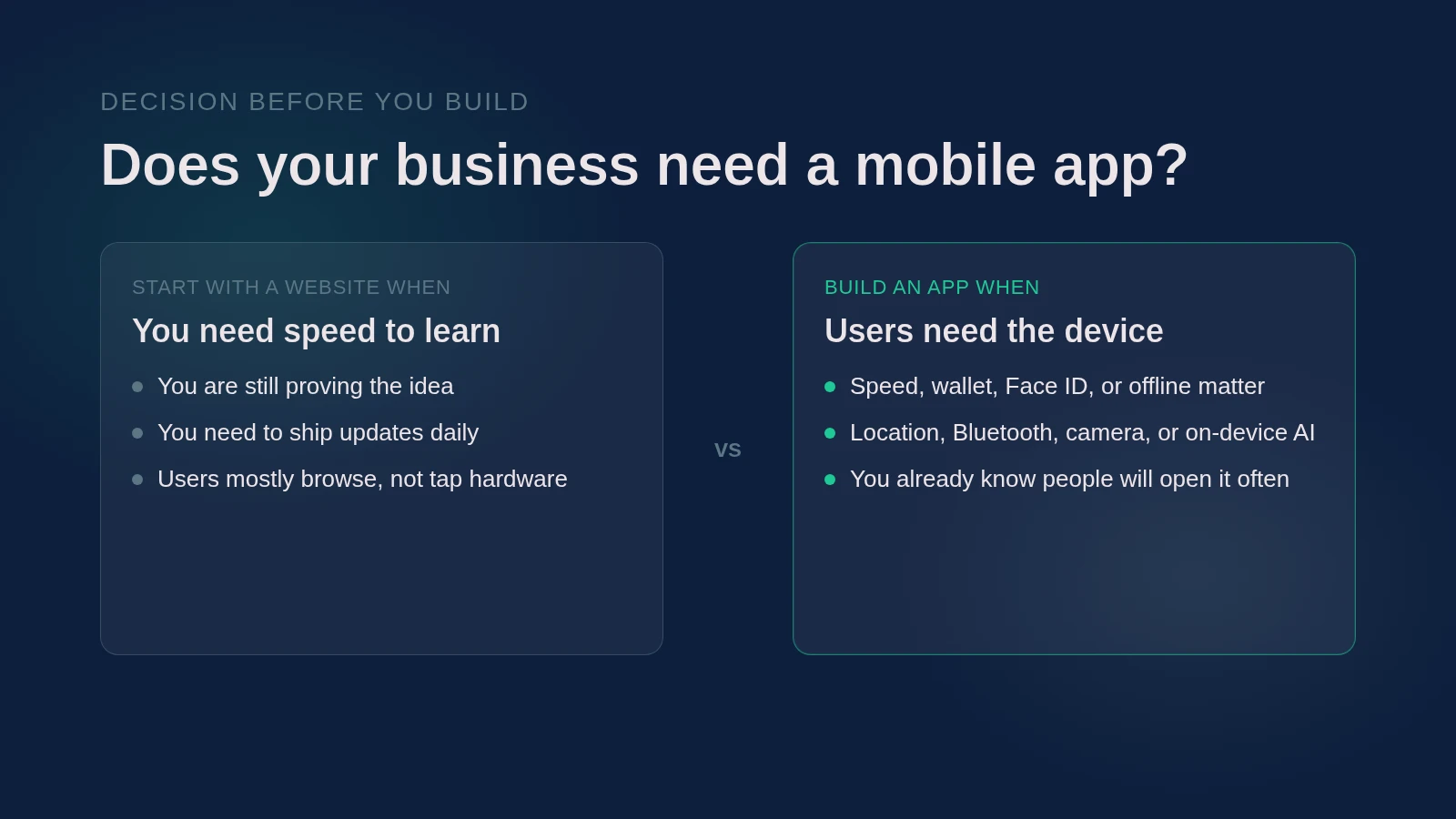
Start with a website when you still need to learn. Build an app when users need the device itself.
Ask why not a website first
If someone brings me an app idea, I ask why they want an app instead of a website first.
A lot of the time the honest answer is that apps feel cool. That is fine as a feeling. It is a weak business case.
Building for the App Store and Play Store is two review systems, two sets of rules, and two sets of platform quirks. Even with Flutter or React Native, you still carry two store dependencies. A website ships when you deploy it. An app update usually waits on review. There are over-the-air update paths, but they have their own limits, and they do not erase store rules.
I say this as someone who builds apps for a living: if you need to learn fast, build a website first. Get real use. Iterate. If people start asking for something they can download and keep on the home screen, pivot. That is not failure. That is information.
Mobile usage is real. Roughly nine in ten U.S. adults own a smartphone, and a large share of everyday shopping and browsing already happens on phones. That still does not mean your first shippable product has to be a native app. Mobile web can carry an MVP while you figure out who stays and what they do.
When an app makes more sense from the start
There are cases where waiting on a website is the wrong call.
One pattern I keep seeing is workflow software for people who will not hunt through a browser. I worked with a team building for a retirement and nursing setting with CNAs and related staff on site. They started on the web because it felt faster to ship. The people who had to use it just wanted a button on a tablet. The website was "easy" for the builders and hard for the users. In that kind of environment, a constrained mobile or tablet app can be the clearer path once you know the job.
Hardware is another hard signal. Location services, Bluetooth, camera plus on-device AI, or deep wallet and biometric flows are usually better as apps than as websites. If the product only works when it touches the device well, do not force a browser shape on it.

Device features, frequent return use, constrained UI, and known demand are stronger reasons than "apps are cool."
You still need a return on investment story. Who benefits, your team or your customers? Older users sometimes prefer a big tap target on a tablet. Sometimes they prefer a phone number on a simple page. Do not invent the preference. Talk to the people who will live in the product.
Be honest about App Store work
If you are committed to an app, get ready for limited screens, phone versus tablet layouts, and two operating systems. If you can answer those with clear yeses, you are in better shape than most first-time builders.
App Store submission is not "upload Friday and celebrate." I recently heard from someone whose friend planned a Friday launch and spent almost three more weeks getting through review after fixes and rejections. He got there. He also learned the hard way that store readiness is part of the product.
Learn from how people actually use the product
At CAM Software we built The Resume App. We expected more desktop web use: one tab for the resume, one tab for a job board, copy and paste between them. People did that. They also did it on the bus, at the park, and in short gaps on a phone. Understanding that changed how we thought about mobile.
The more you understand the user, the easier this decision gets. Research before you build. If they want an app, build the app. If a website gets you the learning you need first, build the website.
There is no single right answer here. The only wrong answer is refusing to decide.
If you are weighing website versus app for a real product, the Build path is for a defined mobile scope, and Partner is for embedded product leadership when the decision is tangled with team and delivery. Either way, start from the user, not from the store listing.
Need help with your project?
Chris Martinez
Founder of CAM Software · Mobile engineer
Chris founded CAM Software in 2022. He leads embedded product engineering engagements for established companies with mobile-led products, inherited applications, and delivery challenges. His work spans product alignment, React Native and native mobile engineering, supporting web and backend systems, release reliability, and responsible AI delivery. He also operates software products owned and operated by CAM Software from Northwest Arkansas and works with teams nationwide.