- Published on
Why We're Moving Our Own Apps From React Native to Native
Today I want to talk about something we're changing at CAM Software that we haven't done before. I think it's going to be confusing to some people, especially people who know me and know the work we've done since 2018.
For our own apps, we're moving from React Native to native: Swift and SwiftUI on iOS, Kotlin on Android.
I want to explain why, because I want people to understand that we're doing this on our own record. It's been in the works for a while. We're not just following the latest trend.
Is React Native dead because Shopify went native?
No.
Recently a few companies have come out publicly and said they're moving their mobile apps off React Native and onto pure native. Shopify was the big one. In September they announced they're moving from React Native back to Swift and Kotlin, which got a lot of attention because Shopify was one of the companies that went all-in on React Native back in 2020.
A lot of people read that as the end of React Native. I've been on Reddit and Twitter reading the threads, and a lot of the takes, like the ones in this Hacker News discussion, are "it's because of AI, native is just easier now." I think there's some truth to that, and some that isn't true. Shopify's own reason was that coding agents made building the same feature in Swift and Kotlin cost a lot less than it used to. That's their team and their apps.
So first and foremost: I still think React Native is a perfectly good way to build an app in 2026. I've said it before, and going into 2027 I'll probably say it again. There's nothing wrong with React Native. A lot of it really comes down to preference.
But I want to talk about why so many teams are starting to move, and why we are too.
What React Native still does really well
The good of React Native is, and always will be, that you write one code base, and that one code base is the entire app for both iPhone and Android. There's very little you have to do to make it work perfectly, or near perfectly, on both.
Especially nowadays. I come from an era where we didn't want to use Expo, because Expo was horrendous. In 2026 that just isn't true. When people ask me whether they should start with the React Native CLI or with Expo, I recommend Expo 100 percent, which is funny, because in 2024 I still wasn't recommending it. The React Native team itself now recommends starting new apps with a framework like Expo. (I wrote a longer comparison in Expo vs React Native CLI.)
Expo does so many things faster for you. With EAS you can get builds to the App Store significantly faster and get into users' hands faster. You can still use something like Fastlane, or push over-the-air updates, if you want to. And if you're a small startup with no Macs, as long as you aren't using native-specific packages, you can scan a QR code with the Expo Go app on an iPhone and an Android phone and start testing on real devices.
So there's a lot of good there.
Where React Native still costs you
The downside for me, still today, is that you're very dependent on the packages people are willing to support.
Not too long ago I was working on a project that depended on a package that hadn't been updated since 2020, and we were in 2024. You're at the mercy of the community. If the community moves on to something better, everyone moves over. And if a company or a person is maintaining something important and decides to stop, which is what happened with that package, you're in an even worse spot, especially if it was core to your product.
Shopify's announcement is a live example of this. Part of it covers the open-source React Native libraries Shopify maintains: some are looking for new owners, and one, Restyle, is being archived after 2026. Teams whose apps depend on those libraries now have to plan around that.
Don't get me wrong, you still run into package situations on native iOS and Android. But there's a lot more of it with React Native.
A good example people don't really think about is the camera. React Native doesn't have a built-in camera. You have to bring in a third-party camera library, or the one from Expo, and check that it does what you need. With Swift or Kotlin, the camera is just part of the platform.
Why we're making the switch
The main reason is where devices are going.
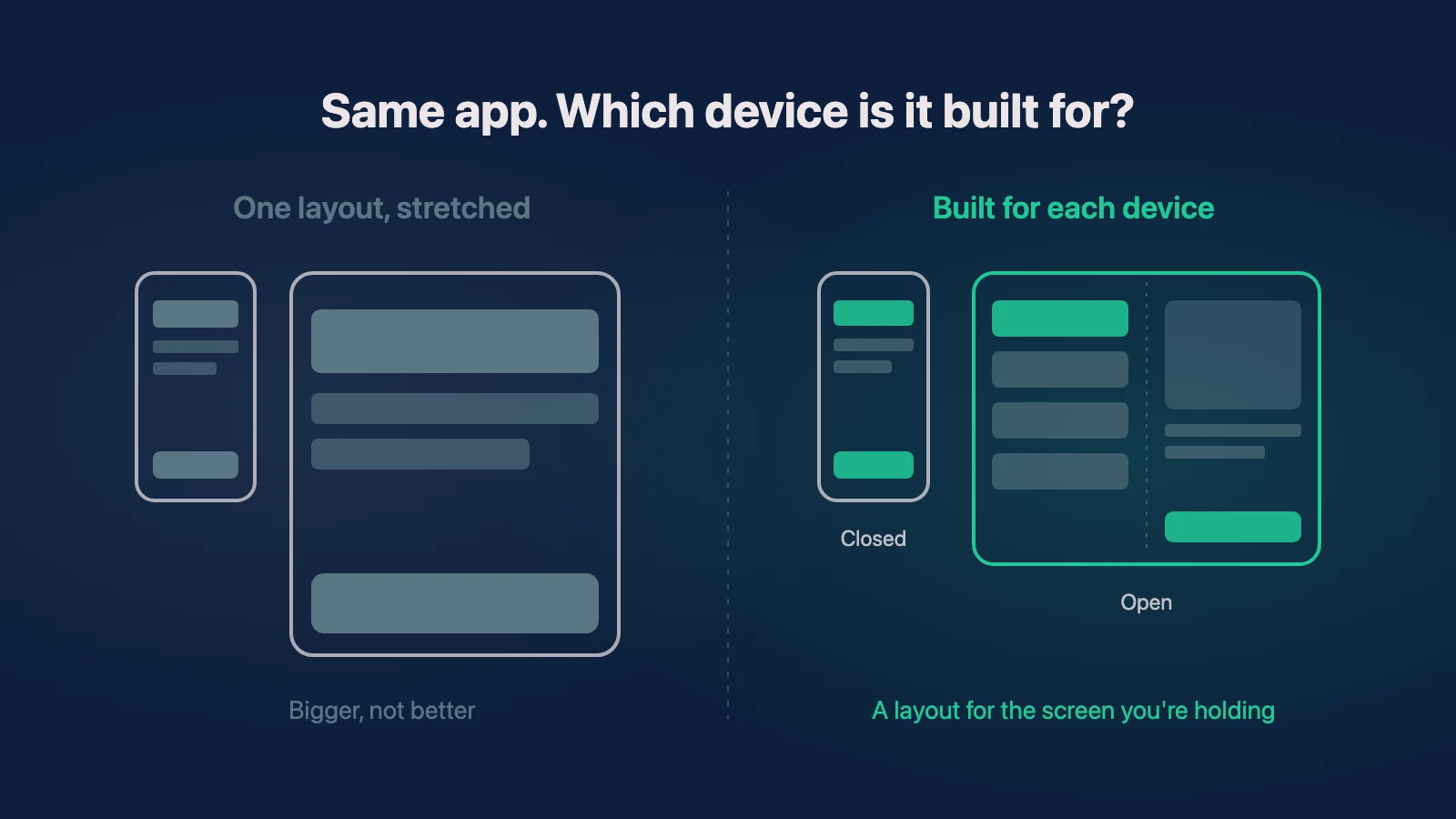
For a long time you could get away with one responsive design that stretched onto any device, and it was fine. One app I think about a lot is Facebook Messenger. On my phone it looks the way you'd expect. On my tablet it looks exactly the same, just enlarged. It's huge. The buttons take up the whole width. The app works, it runs well, there's technically nothing wrong with it, but it looks weird.
That's the trap with leaning on one shared layout for everything. It makes it hard to design the app for each device.
At CAM Software we want to build the best experience for the device someone is holding in that moment. That used to mean phones and tablets. Now it means foldables too, where someone might use your app one way when it's closed and another way when it's open. (If you're wondering whether your own app is ready for that, I wrote about it in Is Your App Ready for Foldable Phones?.)
Maybe we'll be proven wrong in the near future, and the tools will get better. But from what we've seen so far building for Android foldables, it still feels like we need Android Studio and native code to make things right. And in our internal testing, Xcode feels like the better path on the Apple side too.
React Native does let you ask "is this a phone or a tablet?" and change things for that device. Swift and Kotlin let you do the same. But as we got more comfortable working directly in Swift and SwiftUI, we found we could make better layout and experience decisions, and move a little faster and cleaner, especially in our testing for Apple's new foldable, the iPhone Duo.
Is native actually faster than React Native?
For a long time, the honest answer was that most users couldn't tell. To this day, most people won't notice a difference.
But in our own work, we've seen things load faster in native code. It's not a huge gap, and I'm not going to pretend we've done a formal benchmark. For a company that is focused on making things run well for the user, even a little faster is enough of a reason.
What it costs us
We know there are tradeoffs.
The big one is that we now maintain at least two code bases instead of one. If we make a change on iOS, it has to make sense on Android, and there's no guarantee we won't accidentally get something right on one side and wrong on the other. So we have to be very meticulous with our decisions.
The other is the day-to-day work. With one React Native code base, you still compile it to run on a simulator or emulator, but now we're doing that twice. Twice the builds, twice the testing.
We think it's worth it. But it's not free.

The tradeoff as we see it for our own apps.
Does this mean we only build native now?
Of course not.
CAM Software started as a React Native shop. We're still very familiar with it, we still know what we're doing with it, and we're going to keep up with it. That's not going anywhere.
If you already have a React Native app that works and your users are happy, this post is not a reason to rewrite it. I made that case recently in Should You Change Tech Stacks on a Live App?.
And for a brand-new app, we'll keep telling most people the same thing we always have. I think React Native is still the better option for maybe 90, maybe 95 percent of the founders who come to us with a new idea. If we see a reason native would be better for your product at that moment, we'll walk you through it, the same way we would on any Build conversation.
But for the apps we build ourselves, as a company, we're going native, because we think that's how we give people the best experience possible on whatever device they're holding.
These are my thoughts as of today, and I could be wrong about where the tools go next. But that's where we are, and that's why.
Need help with your project?
Chris Martinez
Founder of CAM Software · Mobile engineer
Chris founded CAM Software in 2022. He leads embedded product engineering engagements for established companies with mobile-led products, inherited applications, and delivery challenges. His work spans product alignment, React Native and native mobile engineering, supporting web and backend systems, release reliability, and responsible AI delivery. He also operates software products owned and operated by CAM Software from Northwest Arkansas and works with teams nationwide.