- Published on
Is Using AI Enough to Differentiate Your Startup?
Over the last few weeks I've spoken with enough companies and startups to notice a pattern. A lot of them really believe that applying artificial intelligence to their app or website is enough. That it's going to be the number one thing that gets them more users, more investors, more word out, whatever the case is.
It's interesting how many people have that exact same thought process: we just have to use AI, and everything else will take care of itself.
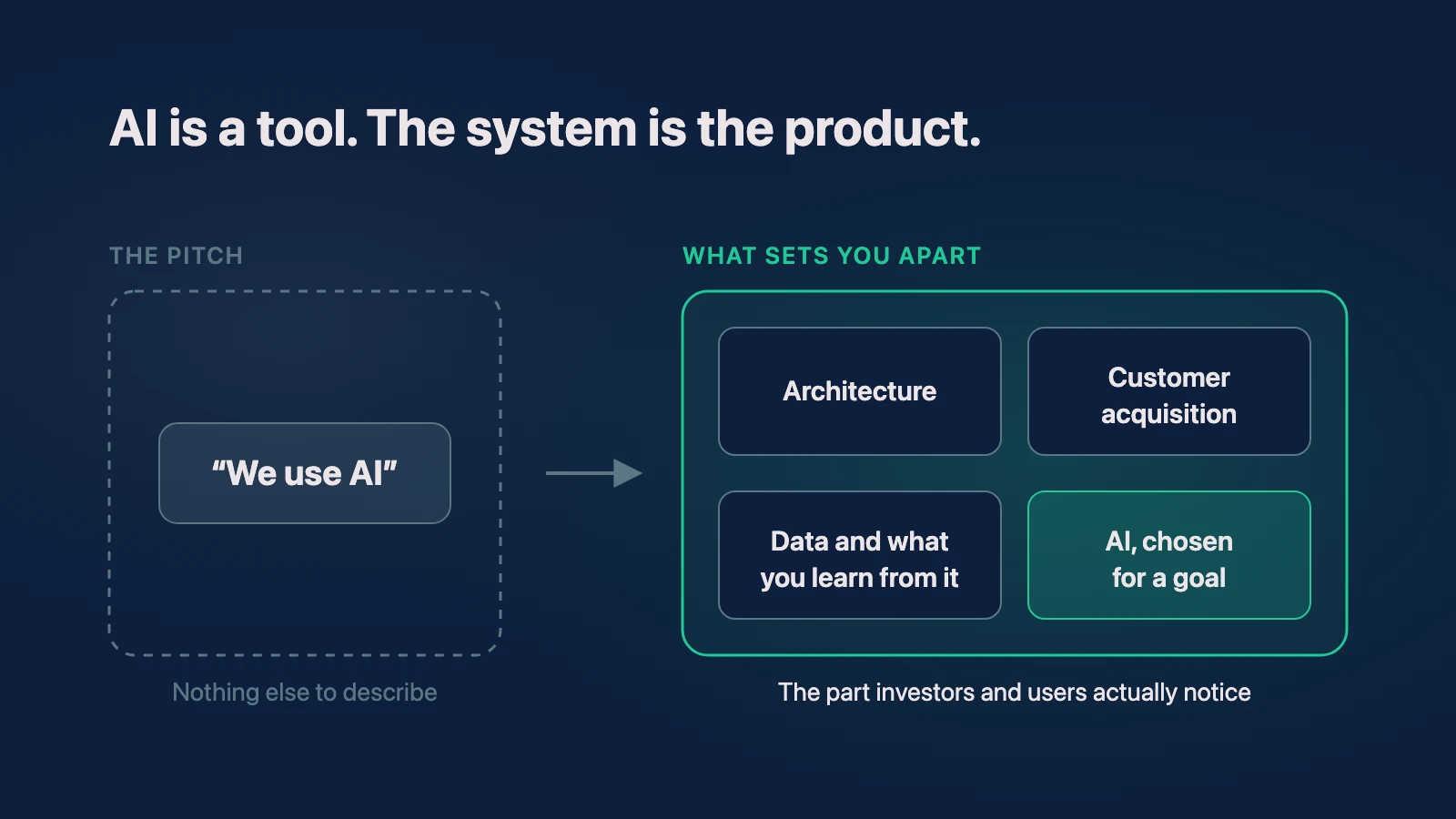
The short answer is no. Saying you use AI is not enough to differentiate your startup. AI is a tool, and it should be used as a tool and a resource to help you move things along. But it isn't going to be the savior, and it isn't going to be the thing that gets you the most money, the best return on investment, or the best developers. What sets a product apart is the plan and the system you build around the AI: who it's for, how it works end to end, how you're going to get customers, and what you do with the data.
I think we're entering a world where not enough people understand that. And if more people did, we'd make better decisions that benefit everybody.
What happens when AI is the whole pitch?
A few weeks ago I was speaking with a local startup. Phenomenal app, and I won't get into the details here. They walked me through their platform, what they're doing, why they're doing it, and why they're excited about the future. Then I asked them a question I think every founder should be ready for: what is the difference between you and every other competitor you have out there?
By the time I met them, I had seen maybe four or five ads for one of their competitors that week alone. No idea how, no idea why. They just kept popping up on social media. So I was hoping to hear something unique.
One of the co-founders told me they were going to use a particular AI tool. It was going to be the best thing in the world for them. It was going to match people better. I thought about it for a second and said to myself, there's no way in the world that makes a big enough difference for anybody to really care.
I've sat in on investor pitches, and I've been part of opportunities where I get to hear someone pitch and then hear the questions and feedback from investors, VCs, angel investors, banks, whoever it is. It hit me almost as soon as I started talking with these guys that it just wasn't going to be enough. Saying you use that tool isn't enough. If they had told me they were going to use Claude or Codex, that wouldn't have been enough either. Saying AI isn't enough.
You need a plan that actually differentiates you and actually does things well for you.
Your idea probably isn't as unique as you think
Here's an example from my own work. A few weeks ago I was talking with someone about The Resume App, and it came out that they and we had the exact same idea. Theirs was geared towards blue-collar workers and ours towards white-collar workers. But the more we dove into the details, the more we realized it was the same thing. The way we wanted to use artificial intelligence to match people. The way we wanted to use it to gather and assess data. The way we wanted to use it to give people a better shot at getting a job, and to help recruiters and staffing firms.
And as we kept talking, we both realized the core of the idea wasn't the AI. The AI was the tool that helped us get a lot of the work done. What was going to make the product good and cohesive was the structure and the architecture around the entire system, from the very first user to the very first staffing firm or recruiter.
I also got to hear how they'd gone about pitching it and trying to raise money, and I realized that in some ways we had actually been selling ourselves a little short. They had done a lot of work there that helped us, and I'm certain hearing our side helped them as well. Those are the conversations that come out best: the ones where you spend the time talking about the actual product.
I bring this up because a lot of first-time founders and first-time developers are afraid to talk about what they're building. I was too when I first started. Don't get me wrong, there are things you shouldn't share. Sensitive or proprietary information, a specific algorithm you're running, anything that's really going to change the world, keep that close. But I'm going to be honest with you: a lot of what most of us are building isn't that special.
I heard someone make this point in a video recently, and I can't remember who it was. There are more than eight billion people on this planet. The chances that you and only you have the idea you're working on have to be really low. Me finding another company with nearly the same idea as ours proves the point.
If the idea isn't the moat, and the AI isn't the moat, then the moat has to be how well you build and run the thing.
Do accelerators and investors care that you use AI?
I recently started mentoring at Fuel, the accelerator here in Northwest Arkansas, and this year's cohort is focused on AI and machine learning. When I spoke with the director, we were curious how they got down to their final group of companies. She told us they were really looking for people who could scale: companies that could grow quickly, or run their business at a much higher capacity than they do now.
Having spoken with several of those companies, I agree with that completely. Most of them, if I'm being honest, were very machine-learning heavy, not very AI heavy. But the thing she really cemented for me was that when they reviewed applicants, they were not at all looking for anyone who was just putting a ChatGPT wrapper, or some other AI wrapper, on their project.
There was a time about a year ago when a lot of new apps were essentially ChatGPT wrappers with nowhere to go from there. We don't see that as much today. What we do see is a lot more people who think that saying they use artificial intelligence is enough, and hope everything else will take care of itself. Again, that's not true. You need a system in place for how you're using AI in your app or website, and a goal for what it's there to do. It cannot be the entire thing.
I also think treating AI as a tagline hurts more people than it helps. It hurts the investors, obviously. But it also hurts the builders, who end up relying on something that might not help them much later, or that is barely being used today. Then they realize it was never the core of the product, and the investors decide it isn't what they were looking for.
Why the newest model isn't automatically your advantage
One more thing I think is crucial for founders to understand: we still don't know everything these models can and can't do.
About a year and a half ago I went to an AI meetup where people were talking about how researchers were still figuring out what the models of that time were capable of and where their limits were. It sounded like we didn't know even 10% of it. Here we are a year and a half later with dozens of models that are completely different, much better and much stronger, and we still don't fully know. Each model has its own personality and its own quirks. If you're not careful with how you use them, you can accidentally do something harmful to your app without recognizing it.
I can't tell you the number of times I've seen someone build an app with AI, switch from one model to another, and sometimes it works out really well, and a lot of times something is missing. Having the latest frontier model does not guarantee the best result. You need to use the models that actually benefit you.
On The Resume App, until recently, we were using GPT-4.1 nano. Very low cost, very effective, and it did exactly what it needed to do. Now that we're upgrading, we're moving to GPT-5.6 Luna, not because it's the biggest model available, but because it works just as well for what we need, and in some places I'm finding it runs even better. I wrote more about how to decide when a new model is worth it if you're facing that choice.
The point isn't which model you pick. The point is that you picked it on purpose, for a reason you can explain.
What should you say about AI instead?
So the question isn't whether you should use AI. Of course you should use artificial intelligence in your work. Use it however you see fit and find out where it's best for your product. I've written about good and bad ways to bring AI into a business, and I'm still very much in favor of it.
Just don't make it the entire central body.
If you walk into a pitch and say "we're using AI," and that's all you can describe about your system, you're going to be laughed at in just about any investor pitch you walk into. But if you can talk about how AI fits into an architected system behind it, how you're actually going to acquire customers, and how you're using the knowledge and data you collect, then you have a fair chance at actually making it.
That system is the part that takes real product and engineering work, and it's the part we spend most of our time on when we build an app.
These are my general thoughts from the conversations I've been having, and I could be wrong on some of the details. But I think this is more true than not: take the AI, use it to the best of its abilities, and understand that it isn't the savior you're looking for it to be.
Need help with your project?
Chris Martinez
Founder of CAM Software · Mobile engineer
Chris founded CAM Software in 2022. He leads embedded product engineering engagements for established companies with mobile-led products, inherited applications, and delivery challenges. His work spans product alignment, React Native and native mobile engineering, supporting web and backend systems, release reliability, and responsible AI delivery. He also operates software products owned and operated by CAM Software from Northwest Arkansas and works with teams nationwide.